Wednesday, February 18, 2015

The Internet Meme

The Internet meme is a mainstay of our current digital culture. It is a concept, phrase, or piece of media that popularizes and spreads across the Internet. Now the definition of a meme in general is, "an idea, behavior, style, or usage that spreads from person to person within a culture" (according to Merriam-Webster). You may notice that these two descriptions of the words are similar, yet when we think of an Internet meme we think of something extremely specific. We think of a GIF with some text layered on top of it. However, it is important to realize that even this seemingly simplistic idea of an Internet meme can often become a widely proliferated idea. Here are just a few examples of popular Internet memes, see if you recognize them.Forever AloneScumbag StevePhilosoraptor(Knowyourmeme.com)

It's funny because even these simple Internet Memes all have their own unique purpose. The first is the Forever Alone face. It's a basic yet funny picture used to convey this more complex emotion of solitude or loneliness. It is also just one part of a larger family of Internet memes called the Rage Faces that follow a similar pattern and design to our Forever Alone meme. The second Internet meme example is called Scumbag Steve. I don't actually know if Steve there is a scumbag from that single picture but it sure seems that the Internet thinks so. This meme is used to share anecdotes of people acting like a well...a scumbag. The third meme above is known as the Philosoraptor whose purpose seems pretty evident from its name. This Internet meme is also part of a larger family of advice animals that share anecdotes, advice, or stories.

Looking at these few examples may not grant us a complete understanding of what this word, meme, means in terms of the Internet but it does give us insight into the trends that emerge across the net. The three Internet memes above represent three typical varieties that are commonly used and found across the Internet. An advanced understanding of Internet memes allow individuals to communicate through them to convey emotions, stories, and more.

Internet memes are also distinct from other trends because there is a aura of permanence that surrounds the Internet. The Internet is this strange realm that defies common sense. The idea that what goes up must come down doesn't apply to the Internet. Once something is uploaded it may never come down. Beyoncé learned this lesson the hard way after her performance at the 2013 Super Bowl which spawned this picture.(link to the story about Beyonce's meme)
When her publicist requested BuzzFeed take down the unflattering photos the result was almost entirely the opposite. The photos of Beyoncé trended and spread across the Internet spawning dozens of hilarious memes.

Previously, the Internet meme was admonished as a strange, unimportant, or even ethereal component of the Internet. But this has never been true because memes by their definition are societal trends, and while these trends may change they always exist in some capacity. These days Internet memes seem like an integral part of our digital culture as they are the creations of the Internet as a community. Memes that are relatable, funny, or that draw from real life become popular as dictated by the millions of users on the Internet.

P.S. - great sites to find memes imgur.com, cheezburger.com  and knowyourmeme.com.


Wednesday, February 4, 2015

The Internet - A Modern Human Right?

David Rothkopf, editor for Foreign Policy magazine poses a new and challenging question for us as a society in his article titled: Is Unrestricted Internet Access a Modern Human Right?

Anyone familiar with my blog will come to know that I value the Internet as an extremely formative force of our modern society. It shapes the way we communicate, play, work, and everything in between. Based on this axiom I think that Rothkopf makes a number of striking points as to why Internet access should be a human right.

To me it seems that people perceive the Internet as a luxury. But as luxurious as it sounds there are already billions of people online today with an increasingly larger number of people logging in for the first time with each passing year. There honestly isn't a single day where I don't use the Internet in some way or another and at this point in my life it is essentially a need for me to live. 

For instance, in his article Rothkopf observes how mobile banking has become exceedingly common, thus diminishing the number of times that transactions require the physical passing of money. Every time I swipe my debit card at a restaurant I make a transaction without even realizing it. As such, the Internet has quite literally de-materialized money.

Actualizing universal Internet access as a goal though is as tricky as one would think. For one, it requires a source of electricity which begs the question that affordable, accessible energy should also be a human right (yes). It also requires governments giving its people a certain level of freedom that to some of the more repressive regimes in the world might be dangerous. For example in China, your Internet access would be screened, limited, and monitored by the state.

While there are obvious obstacles, I believe that these are changes that must and will be executed in the future. As the Internet becomes increasingly a part of more and more peoples lives it will become harder and harder to keep people disconnected. After all, technological advancements have been changing the world since the dawn of the printing press and the latest revolutionary technology is the Internet. 

Friday, January 9, 2015

Expanding Perspectives on Iran - A Book Review

I have recently been reading more on Iran. It is a nation with a complex and rich history that has always been relevant in international relations. In class I have been reading and discussing the book Reading Lolita in Tehran by Azar Nafisi which offers a memoir recounting for life under the regime in the 1980s. In reading this book I have gained a new perspective and better understanding of Iran. Also because of this book, I became interested in expanding my perspective on Iran. I chose a much more modern issue to explore however; it was the issue of nuclear proliferation.

I recently read Can the World Tolerate an Iran with Nuclear Weapons? by Amos Yadlin, Charles Krauthammer, Fareed Zakaria, and Vali Nasr. This text was actually adapted from a series of debates called the Munk Debates which is a series of semi-annual debates that cover a wide range of topics both domestic and foreign.


Can the World Tolerate an Iran with Nuclear Weapons?

This text was particularly interesting to me because it included the perspectives of four different individuals who all brought something different to the table. Yadlin is from Tel Aviv University's Institute for National Security Studies and was a former head of the Israel Defense Force's military intelligence.  Krauthammer is a columnist for the Washington Post and a Pulitzer Prize winner. On the other side of the debate we have Zakaria who is the host of his own series on CNN called Global Public Square. Last but not least offering his own Iranian perspective is Nasr who is a dean of the Johns Hopkins School of Advanced International Studies.

This text was rather digestible and easy to read because it focused on the debate over a single issue. I think that Krauthammer on the Con side and Zakaria on the Pro side were the two voices that stood out to me the most. I think because these two are not just dry academics but scholarly journalists that they were better able to convey their argument concisely and in a manner that is more accessible to people today.

On the Internet, Krauthammer and Zakaria are both two blogs that I follow (links included) and part of the reason that I was compelled to pick up this text. One of my favorite aspects about the Internet is its ability to convey a multitude of perspectives. Can the World Tolerate an Iran with Nuclear Weapons? shares this similar trait and is likely why it was perfect for me as someone who was searching to expand his own perspective on Iran.

Regarding the debate itself I found myself persuaded by the side of Zakaria and Nasr that the world could tolerate a nuclear Iran. The non-proliferation treaty or NPT seems now like a rather dated structure for governing the nuclear ambitions of a growing number of nations. The threat of hyper proliferation and induced instability also seem hyperbolic to me after reading the text. Ultimately though, the text conveyed both sides adequately and the coverage was excellent and definitely worth reading.

Personally, I was happy to gain the insights on this debate especially since this is part of an ongoing current discussion in foreign policy today. There have been discussions back and forth between the US, Iran, and other world powers regarding the nuclear status of Iran and reaching a resolution is believed to be critical to all parties involved. With my newly gained perspectives this is also an issue that I will continue to follow more closely in the coming months. Who knows, it might even be worth a blog post.


Thursday, December 18, 2014

Evolving Media and the Middle East

The power of media to control the image, perception, and understanding of the world is nothing new. But today the Internet provides an unprecedented tool for media manipulation. A far too often victim of this media control is the Islamic world.

Words like "extremism", "terrorism", and "fundamentalism" are all thrown and carry weight when used to describe the Islamic world. But our western negative perceptions of the Middle East and Islam are not divorced from the history. The "Afghan Girl" story is a perfect example of this and one that we discussed today in my English class.
(Nat Geo)
Afghan Girl

In the '80s, the popular magazine, the National Geographic released a story about the "Afghan Girl" that garnered national attention during a time when the world was shifting its attention to the country of Afghanistan. Now again we see these emerging trends as the world looks to countries like Iraq and Syria midst the turmoil stirred up by the expansion of ISIL and the Assad regime.

It is a much different story this time around though, with the Internet we get a portrayal of the Middle East that focuses almost entirely on negativity, violence, and instability. So how are we able to correct this image? I suppose it would require the Internet collectively shifting to focus on other more positive stories. This is important because the attitude of the Internet determines the attitude of much of the world, especially the West.

Additionally, we need to realize the stereotypes that we perpetuate across media about the rest of the world. Often times, foreign issues, especially those regarding Middle Eastern nations, are complicated but reduced to a very bare-bones explanation by Western media.


Monday, December 15, 2014

The CIA Torture Report

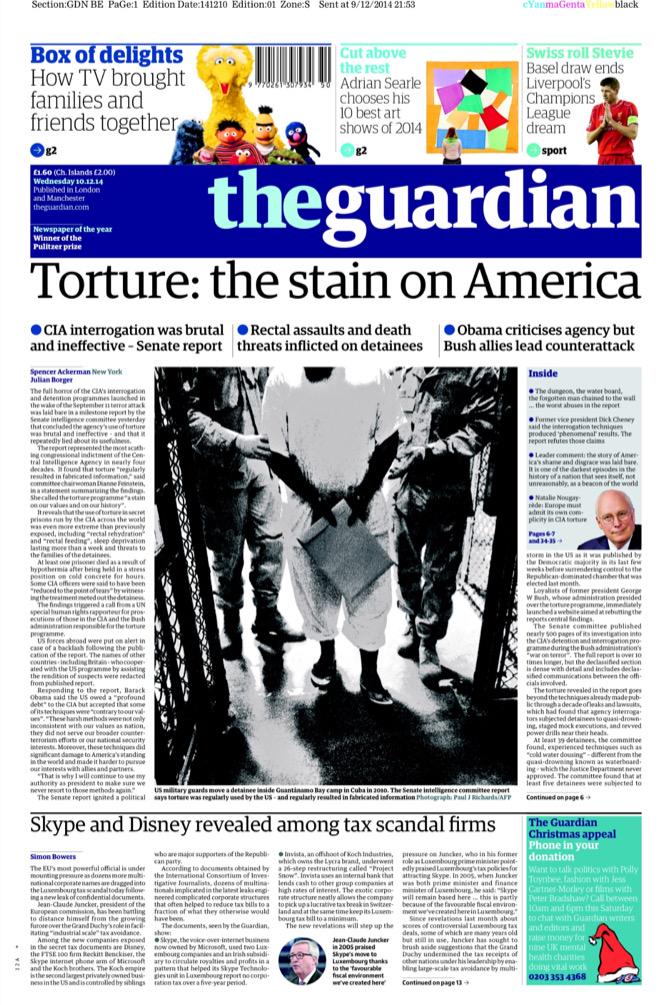
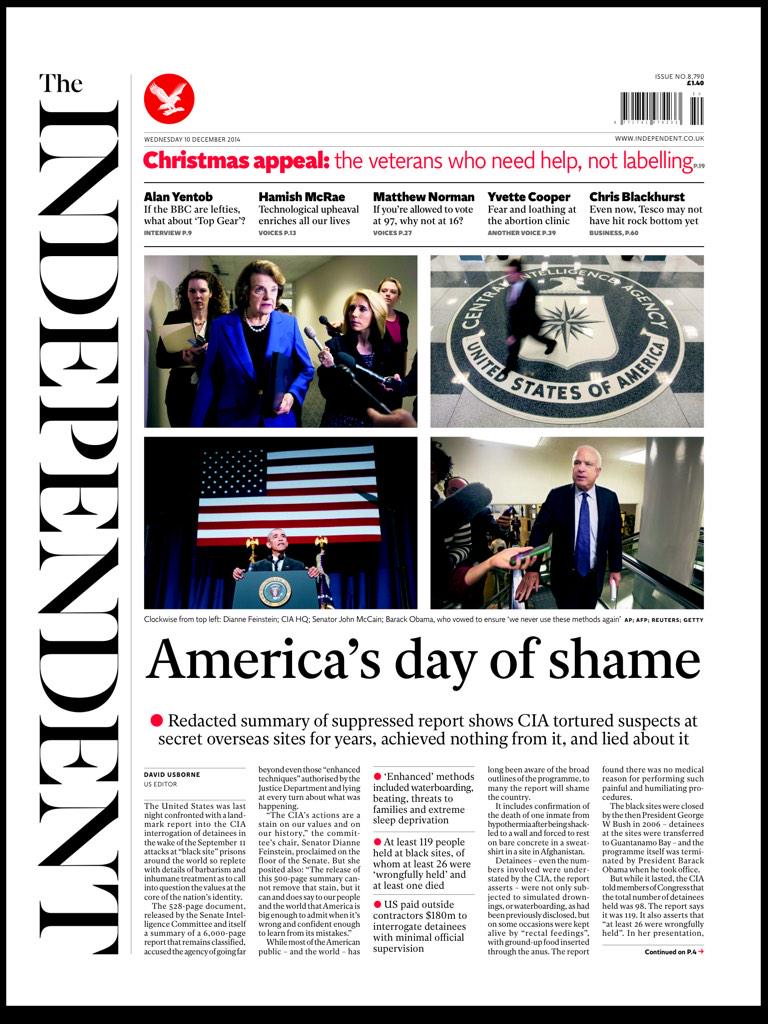
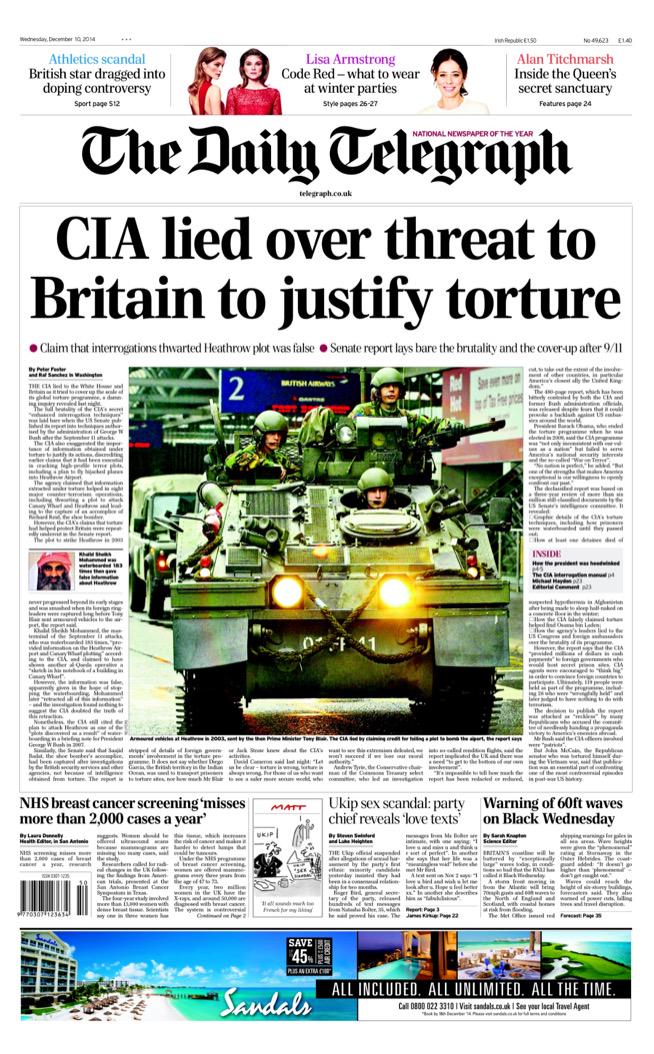
Last week's release of the CIA torture report was expected to cause massive backlash and outcry. The report included hundreds and hundreds of pages detailing tactics employed by the CIA post 9/11 as a means of torture. These methods included water boarding, sleep deprivation, hosing, rectal insertions, and more. Republican representative Mike Rogers had even been quoted saying, "our own intelligence community has assessed that this will cause violence and death" commenting on the release of the report and prior to the release U.S. facilities abroad were put on high alert.

So I suppose the question remains of what did happen? There obviously was a response to the report though it may not have been in the way predicted by the intelligence community. This was a story that took shape on the Internet and social media in a lot of different ways.

For one, the Twitterverse exploded with trending hash tags like #TortureReport. People, as they now often do, took to their keyboards in protest of what they didn't like. Additionally, dozens and dozens of articles and stories were published online that disseminated and concentrated the broad depth information from the released report into manageable lists. I've recently seen a bunch of varying "top 10" lists about the report. Even international sources like the Russia Times made their own list. These articles mainly made the report a more accessible story than upon its release. For the general public, sifting through hundreds of pages of CIA excerpts isn't something of interest. Luckily, the Internet has created an age of summaries and SparkNotes. You no longer have to read the book to know the story and the same practice applies to here to the CIA torture report.

Other large news sources from around the world also picked up the story of the CIA torture report and condemned the U.S. for its actions.

(Photos from USA Today)
 

Ultimately, we are likely just lucky that the backlash and response wasn't more turbulent or violent in nature. But the unraveling of this story is important. The acknowledgements made by the government were not an easy move to make and in our current age being given transparent information is rather a rarity. The U.S. for the last week has been subject to severe criticism but I think senator John McCain said it best when he stated that the "question isn't about our enemies; it's about us. It's about who we were, who we are and who we aspire to be. It's about how we represent ourselves to the world." 

Wednesday, November 19, 2014

The Internet and ISIL


I think Stephen Colbert hit the nail on the head, as he usually does, when he commented on how certain stories dominate our news cycle. Here’s the link to what I’m talking about, http://thecolbertreport.cc.com/videos/e50viy/intro---10-8-14. He talks about, “the latest in the war against ISIS, then to cheer you up the latest on Ebola. Colbert is satirizing America’s obsession with certain stories that are negative and sensationalized in the media.
ISIL and Ebola. What makes these topics different than others as to deserve them so much coverage over the past several months? I want take this opportunity to explore these stories. In this post I want to explore ISIL and how and why it became such a media wildfire. In another post, I hope to discuss Ebola as well. 
But beginning with ISIL, this terrorist organization caught national attention in August with the brutal decapitation of American journalist, James Foley. To make matters worse, they published a video of this act that proliferated through the Internet. In doing so, this is an organization that has actively sought the attention of the Internet and media. 
On November 16, 2014, ISIL published yet another video message, depicting the beheading of American hostage Peter Kassig, also known as Abdul-Rahman Kassig (here is a link to a story on Kassig http://www.usatoday.com/story/news/world/2014/11/16/peter-kassig-islamic-state-claims-beheading-syria/19128067/). This makes five westerners who have been beheaded on video messages. 
These examples are to prove something: ISIL is a media monster. From twitter campaigns, to video messages of killings, to recordings from its leader Abu Bakr al-Baghdadi that threaten the U.S. and its allies, it is clear that ISIL is set apart by its ability to use social media and the Internet as a new medium to install terror. They even built a downloadable Android app. 
Above, we mentioned ISIL’s proficiency at using video messages. ISIL’s twitter strategy is also similarly frightening. For one, supporters that download the organization’s app instantly retweet any message sent out by ISIL giving the appearance of broad support. Additionally, the organization often tweets using popular hashtag such as #Worldcup. Thus, by following global Twitter trends ISIL is able to shoot out their message to more and more screens (here is a link explaining ISIL’s social media strategy further http://www.theatlantic.com/international/archive/2014/06/isis-iraq-twitter-social-media-strategy/372856/#disqus_thread).
 This is how ISIL captured global attention. In the U.S., this combined with our fascination of gruesome imagery is what made ISIL into a story that gained so much attention. At this point I think it is important to take a moment to realize the impact that the Internet has had on this story. There are literally international terrorists using the Internet as a tool for their propaganda. This proves to be another example of the far reaching implications of the Internet and how it is changing our modern day world. 

Monday, November 3, 2014

The New Debate over Net Neutrality


The degree to which your Internet Service Provider or ISP controls your networking is probably more than you realize. The term Net Neutrality is the principle that your ISPs should enable access to all content and applications regardless of the source, and without favoring or blocking particular products or websites.

To understand the actions of these ISPs I think it helps to use a highway analogy. Companies like AT&T, Verizon, Comcast, or other cable companies provide Internet access but often times partition this access into fast lanes and slower lanes. So when you try to download content from sources like Netflix or Hulu these ISPs get to determine how fast these services reach you.

The National Urban League President Marc Morial is just one of the many that have  expressed his opposition to new Net Neutrality proposals made by the FCC (http://www.huffingtonpost.com/craig-aaron/why-is-the-national-urban_b_6066884.html -- here is a link to a Huffington Post blog on the matter). The problem is that allowing ISPs to control coverage and internet speeds allows for discriminatory practices. This is a new era of discrimination: online discrimination.


Why does this matter? It matters for one reason because companies like Netflix are actually competitors of companies like Comcast battling for the viewership of their audience. Secondly, certain companies can pay these ISPs so that their service reaches you faster.
The impact to the individual is the dreaded......loading screen and obviously because slow connection times turn off consumers from products. But the broader impact however is that these practices, while determined legal by the FCC, are disadvantageous to the interests of smaller companies who cannot afford to pay the Internet tolls of these cable companies.

The Internet in all its wonder is amazing because it is a platform for self expression unlike any seen before in history. The reason this all works though is because of the freedom and accessibility of the Internet. But when the Internet is no longer free and accessible it is no longer what it is meant to be.
The Huffington Post blog also discusses how the loss of real Net Neutrality will make it harder for colored communities and marginalized groups to express themselves. These tend to the be smaller content producers that can't compete in a world dominated by cable companies and their interests.

Yet, at the same time there are organizations such as the National Urban League that works in a close philanthropic relationship with large ISPs. So, now the debate gets even murkier when there are certain civil rights groups that oppose possible Net Neutrality rules.

In the larger picture of things, it seems that individuals like Morial support the idea of open Internet as a concept but still want to empower ISPs to control and discriminate online. This is simply a solution that won't work. Reducing ISPs to “common carriers” meaning they have to serve the public indiscriminately is the only way to ensure a future of real Net Neutrality.

Here is also a video that also helps understand Net Neutrality -- http://youtu.be/2psly3euy78.